Projects
Printed before it's a shirt.
What if a garment only came into being once it was ordered? Made to exact measurements and printed in places no machine can reach on a finished shirt. That is exactly what Smake researched together with the Institute for Textile Technology at RWTH Aachen University.
The idea: produce when it's ordered
Conventional textile production thinks in quantities and standard sizes. The microfactory turns this around. Customers enter their own measurements, and an individual cutting pattern is created from them. Production only starts once the order is in, for a single piece just as for a small series.
An example from the project: a short-sleeved basic shirt became a long-sleeved shirt, made exactly to the requested measurements.
Print first, then sew
The decisive difference lies in the order of steps. It is not the finished garment that gets decorated, but the flat fabric, before it is cut and sewn. This allows designs to run across seams, edges and sleeves. Areas that no printing machine can reach on a finished shirt become part of the design.
- Capture measurements
- Generate cutting patterns
- Print the fabric
- Cut and sew
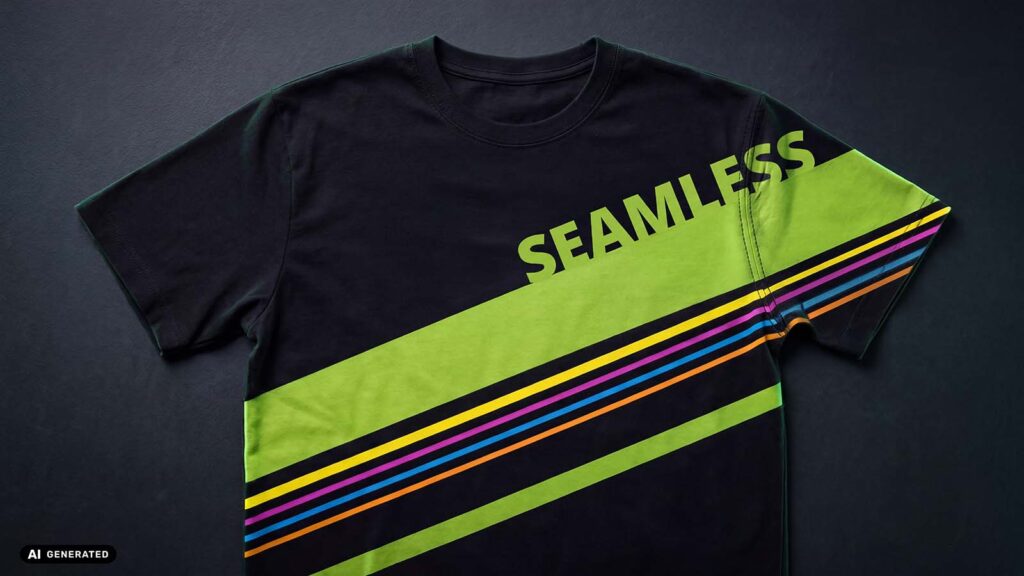
Printing where it's no longer possible on a finished shirt.
The role of Smake
For many individual parts to become a garment that fits, every station needs to know what it is working on. This is where Smake comes in: the software guides the order from the online shop through pattern data and printing all the way to the sewing station. At every step, it is clear which cut piece belongs to which order and what happens next.
The process fits seamlessly into the existing Smake workflow. For producers, this means new decoration possibilities without giving up the familiar control of their production.
Together with partners
The microfactory started in 2022 as a funded research project. Alongside Smake and the ITA, partners from Brazil were involved, including a sportswear manufacturer. Together, the process from order to sewn piece was played through and tested in a prototype.
A look ahead
Set up as a research project, the aim was to test and understand the process. Back then, the idea was ahead of its time. Today, more and more companies are turning to microfactories, and AI makes steps such as capturing measurements, generating cutting patterns or placing designs much easier.
The idea from back then is closer to reality than ever. And Smake already knows how it fits into a connected production.